

In a high-end home, interior painting is judged in the details that remain after the crew leaves. Look for even sheen across broad walls, clean lines at millwork, protected floors and furnishings, and a finish that supports the architecture. Choosing the right team means evaluating the process behind the result, not simply viewing a gallery of finished rooms.
Contact Faros to discuss your Denver Metro Area remodeling or construction project.
The best luxury home interior painting specialists explain how they inspect surfaces, prepare each area, coordinate colors and finishes, protect architectural features, communicate throughout the work, and verify the result during a documented final walkthrough.
Those standards give homeowners a practical way to compare providers while keeping expectations clear. Start by asking prospective teams to show how their past work, preparation practices, detail control, and project oversight support the level of finish your home requires.
What should luxury home interior painting specialists be able to show you?
A qualified team should be able to show more than attractive room photographs. Look for clear evidence of consistent finishes, careful detail work, protection of the home, organized communication, and accountable oversight from the first conversation through the final walkthrough.
Start with a relevant portfolio. Ask to see completed interiors that resemble your home’s level of detail, not just a collection of dramatic reveal images. Look closely at transitions around trim, doors, ceilings, built-ins, cabinetry, and changes in color. A useful portfolio should help you assess how the team handles quiet, highly visible details, including long walls, narrow edges, corners, and areas where natural light exposes uneven work.
Ask what the photographs demonstrate. Were the surfaces carefully prepared? Were architectural features protected during the work? Does the finish remain visually consistent from one room to the next? A specialist should be comfortable explaining the project conditions and the decisions that supported the result. If the portfolio provides no context, request a conversation about the preparation, sequencing, and inspection standards behind the images.
Evaluate finish consistency in person when possible. High-end interiors are judged across an entire room, so inspect broad surfaces under different lighting. Look for smooth transitions, clean lines, even coverage, and a controlled appearance at edges. You should also ask how the team reviews its work before presenting it for approval. A defined inspection process is more meaningful than a general promise to provide excellent craftsmanship.
Pay close attention to detail control. Ask how the team plans to work around millwork, hardware, light fixtures, flooring, built-ins, and other finished features. The answer should address protection, clean work areas, daily site control, and communication when an existing condition needs attention. For broader guidance, you can review how to choose a residential painter while keeping your questions focused on the higher standards of a detailed interior.
Confirm who remains accountable. An owner-led team should be able to explain who evaluates the home, coordinates the work, communicates updates, and participates in the final review. Faros is a family-owned, owner-led construction company serving the Denver Metro Area, with Ricardo Alfaro directly involved in project oversight. Meet the owner-led team and look for evidence of direct communication, clear expectations, and a structured closeout process.
The strongest choice is the team that can connect its portfolio to a practical process. When the examples, preparation standards, detail checks, and accountability structure all align, you have a clearer basis for deciding whether the team is prepared to care for a high-end interior.
How does surface preparation protect a high-end finish?
Surface preparation protects a refined interior finish by giving each coat a stable, clean, even surface to bond with. The work should move in a deliberate sequence, from inspection and repairs to cleaning, sanding, priming decisions, and a final readiness check before application begins.
Inspect every surface and identify repairs
A careful inspection looks beyond the existing color. The team should note dents, nail pops, cracks, uneven patches, peeling areas, stains, exposed fasteners, and changes in surface material. It should also identify transitions between drywall, plaster, wood, metal, cabinetry, and previously coated surfaces. These conditions affect how the finish will appear under natural and artificial light. Confirming the existing condition before work starts creates a practical scope and prevents small defects from being hidden under fresh paint.
Complete repairs and allow them to settle
Repairs should be completed with materials suited to the surface, then allowed to dry or cure as directed. Patching a wall is only the first step. The repaired area must be blended into the surrounding surface so it does not create a visible ridge or change in texture. Trim joints, corners, and transitions deserve the same attention as broad wall areas, especially in rooms with strong daylight or detailed millwork.
Clean, sand, and remove residue
Dust, grease, soot, and residue can interfere with adhesion and make an otherwise careful application look inconsistent. Cleaning should be appropriate for the substrate, followed by controlled sanding where needed to smooth repairs, dull glossy areas, and soften rough edges. The surface then needs to be cleared of sanding dust before any coating is applied. Homeowners can review related preparation guidance in this guide to preparing a home for interior painting.
Choose primer based on the condition
Priming is a decision, not an automatic substitute for preparation. A specialist should explain when a repaired area, porous substrate, stain, color transition, or other condition calls for primer and when thorough preparation is sufficient. Product selection should follow the surface and project requirements rather than a one-size-fits-all routine. For occupied homes, ventilation and product information also deserve attention. The EPA’s guidance on volatile organic compounds and indoor air quality recommends source control and ventilation to help reduce indoor concentrations.
Verify transitions and readiness before application
Before the first finish coat, inspect corners, ceiling lines, trim edges, repaired areas, and changes between adjacent materials. Protection should be in place, surfaces should be clean and dry, and the room should be ready for an orderly application. A brief readiness check gives the homeowner and project lead an opportunity to resolve overlooked defects before they become visible in the finished work. This disciplined sequence is one of the clearest signs that a team treats craftsmanship, communication, and lasting results as connected responsibilities.
How should a painting team protect architectural features?
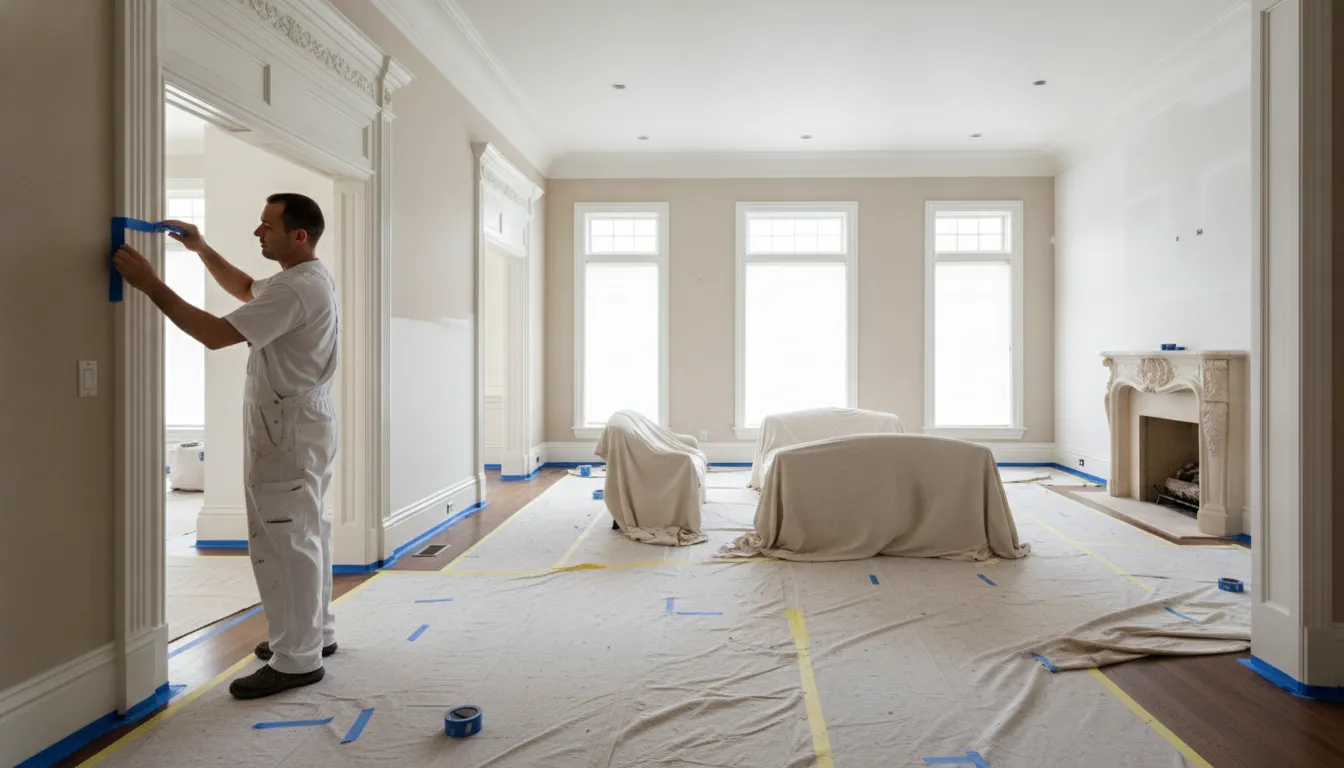
A careful painting team protects the home before applying a single coat. That means identifying finished surfaces, documenting vulnerable details, planning access, and controlling the work area throughout the project. In a high-end interior, protection is part of the workmanship, not an afterthought.
Floors should be covered with materials appropriate to the surface and secured so they do not shift into walkways. Protection should extend beyond the immediate wall. Stair treads, thresholds, stone, wood flooring, and transitions between rooms all deserve attention because dust, tools, and ladders can move beyond the active work zone. A team should also confirm how coverings will be removed without dragging debris across finished surfaces.
Protect details that cannot be replaced easily
Millwork, cabinetry, built-ins, and decorative trim often define the character of a home. Before work begins, the team should inspect these features and clarify which surfaces are being painted, which remain untouched, and how edges will be separated cleanly. Doors, drawer fronts, shelves, and fitted panels may require careful masking or temporary removal when access makes that the safer choice.
Hardware should be removed or protected deliberately rather than simply covered in place. Hinges, pulls, locks, outlet covers, registers, and other fixtures can collect paint or become difficult to operate when edges are not controlled. Lighting requires similar care. Fixtures, switches, recessed lights, and adjacent electrical components should be isolated from dust and splatter, with the work sequence coordinated so the room remains safe and usable.
Discuss daily site control before the project starts
Protection also depends on what happens between work sessions. Ask who manages daily cleanup, where tools and materials will be stored, how rooms will be secured, and how residents, pets, and other trades will move through the home. A dependable team should explain its approach to access, ventilation, debris removal, and communication when conditions change. The EPA identifies source control and ventilation as ways to reduce indoor concentrations of volatile organic compounds, so indoor-air questions should be part of the project conversation when products and occupied spaces are being considered. Review the EPA’s indoor-air guidance for general information.
This level of coordination matters especially when painting is one phase of a broader remodel. Faros brings construction, remodeling, and home-building experience to projects where multiple details must work together. You can learn about home building and remodeling services or explore the broader construction and remodeling services before discussing the needs of your Denver Metro Area home.
How do color coordination and finish choices support the whole home?
Color coordination works best when each room feels intentional while still responding to the home’s architecture, natural light, furnishings, and adjacent spaces. A careful review of color relationships, finish levels, samples, and transitions helps luxury home interior painting specialists create a result that feels unified rather than disconnected.
Begin by mapping how rooms relate to one another. A hallway, stairwell, or open sightline can make a color change feel abrupt if neighboring tones have no shared undertone or visual connection. That does not mean every room should use the same color. It means the palette should be reviewed as a whole, including trim, doors, ceilings, cabinetry, built-ins, and accent areas. Existing stone, wood, tile, metal, and upholstery should also be considered before final selections are documented.
| Decision area | Questions to ask | Quality check |
|---|---|---|
| Color relationships | How will this color connect to adjoining rooms and fixed materials? | Review the palette from shared sightlines in daylight and evening light. |
| Sheen and finish | Which finish suits the surface, use, and desired visual character? | Confirm that sheen changes are deliberate and transitions are clean. |
| Samples | Can samples be viewed on the actual surface before approval? | Inspect samples at different times and record the selected option. |
| Documentation | Where are colors, locations, finish choices, and open questions recorded? | Use one current written schedule so the team and homeowner share the same reference. |
Finish selection deserves the same attention as color. Sheen affects how light reflects, how surface texture is perceived, and how a room’s details read. A smooth wall, detailed millwork, door, ceiling, and high-use area may each call for a different finish decision. The right choice depends on the surface and design intent, not on applying one finish everywhere. Ask the team to explain the reasoning in plain language without relying on brand names or vague claims.
Samples should be reviewed on the surfaces where they will be used, with nearby materials visible. Natural light shifts through the day, while lamps and architectural lighting can alter perceived warmth and contrast. Larger sample areas often reveal undertones and texture more clearly than a small color card. Before work begins, document the approved color, room or element, finish, boundaries, and any unresolved question. This record reduces assumptions when rooms meet at corners, door openings, stair transitions, or detailed trim.
A dependable team should welcome these questions and incorporate the answers into the project plan. Faros emphasizes clear communication, direct oversight, and lasting craftsmanship across its broader construction and remodeling work. That same disciplined approach gives homeowners a practical way to evaluate whether a proposed color plan is coordinated, understood, and ready for careful execution.
What communication and inspection standards signal a dependable team?
A dependable team makes quality visible through a clear scope, organized sequencing, regular communication, and a final walkthrough. For a high-end interior, the selection process should test not only painting ability, but also how the team manages details from the first conversation through the last inspection.
Look for a written scope
Ask for a written description of the rooms and surfaces included, the preparation expected, the treatment of trim and built-ins, and the order in which spaces will be addressed. The scope should also identify who will answer questions, how changes will be documented, and what the homeowner should expect before work begins. This makes the process easier to follow and gives both sides a shared reference point.
Questions are especially important when a home includes multiple finishes, delicate millwork, tall walls, cabinetry, or rooms that connect visually. A careful team should be willing to discuss transitions rather than treating every wall as an isolated task. That conversation can reveal whether the contractor is thinking about the home as a coordinated environment.
Pay attention to project communication
During a consultation, notice whether the contractor listens carefully and explains the sequence in plain language. High-quality communication includes realistic expectations about preparation, access, daily cleanup, drying conditions, and the points when the homeowner will review the work. It also means raising questions early instead of allowing small uncertainties to become larger finish or scheduling issues.
Faros Construction Services uses an owner-led approach, with Ricardo Alfaro directly involved in project oversight. Homeowners can learn more about the company and its approach on the About page. That kind of accountability matters when an interior project touches several rooms, architectural features, and decisions that need to remain consistent.
Define the inspection standard before work starts
A final inspection should be more than a quick look around the room. Walk through the work in the same lighting and viewing conditions the homeowner will use every day. Look for consistent coverage, clean edges, smooth transitions, protected features, and areas that need attention from different angles. Keep a focused punch list, then confirm how each item will be reviewed and closed.
The best selection conversations make this standard clear before the first preparation step. If a contractor welcomes detailed questions, explains how the walkthrough works, and treats correction items as part of responsible project completion, that is a stronger signal than broad claims about being premium. For homeowners coordinating several improvements, Faros also provides broader construction and remodeling services across the Denver Metro Area.
Frequently Asked Questions
These questions help homeowners evaluate preparation, protection, coordination, communication, and final inspection standards before selecting luxury home interior painting specialists for a Denver Metro Area property.
How can I tell whether a painting team will prepare surfaces properly?
Ask for a clear explanation of the inspection and preparation sequence. A dependable team should discuss repairs, sanding, cleaning, priming decisions, and how each step supports smooth transitions and consistent sheen. The written scope should identify preparation work instead of treating it as an afterthought.
How should interior painters protect fine architectural features?
Protection should be planned around the home, not added after work begins. Ask how the team will shield floors, millwork, cabinetry, hardware, built-ins, lighting, and adjacent finished surfaces. Also confirm how materials will be organized and how the work area will be controlled at the end of each day.
Who should coordinate color and finish decisions across multiple rooms?
Color and finish choices should be reviewed in the context of the whole home, including natural light, connected sightlines, millwork, cabinetry, and architectural details. A strong team will document decisions, explain where different sheen levels may be appropriate, and confirm the selections before application begins.
What should happen during the final inspection?
The final inspection should include a room-by-room walkthrough in good lighting, with attention to coverage, edges, transitions, detail work, and protected features. Any agreed corrections should be recorded in a punch list, then reviewed again after completion so the homeowner understands what was addressed.
How important is direct communication on a high-end interior project?
Consistent communication helps protect the sequence and quality of the work. Before selecting a team, ask who will answer questions, provide updates, coordinate access, and lead the walkthrough. Direct owner-led oversight can make responsibilities clearer when painting is part of a broader remodeling or construction project.
Ready to discuss your Denver Metro Area interior project?
Selecting a painting team for a high-end home starts with a useful conversation about the property, the surfaces involved, the finish expectations, and the level of coordination required. Faros Construction Services brings an owner-led approach to residential construction and remodeling, with an emphasis on quality craftsmanship, honest communication, and lasting results. Ricardo Alfaro can help you clarify the next steps and determine whether the project fits the team’s capabilities.
Contact Faros Construction Services to discuss your Denver Metro Area project.