
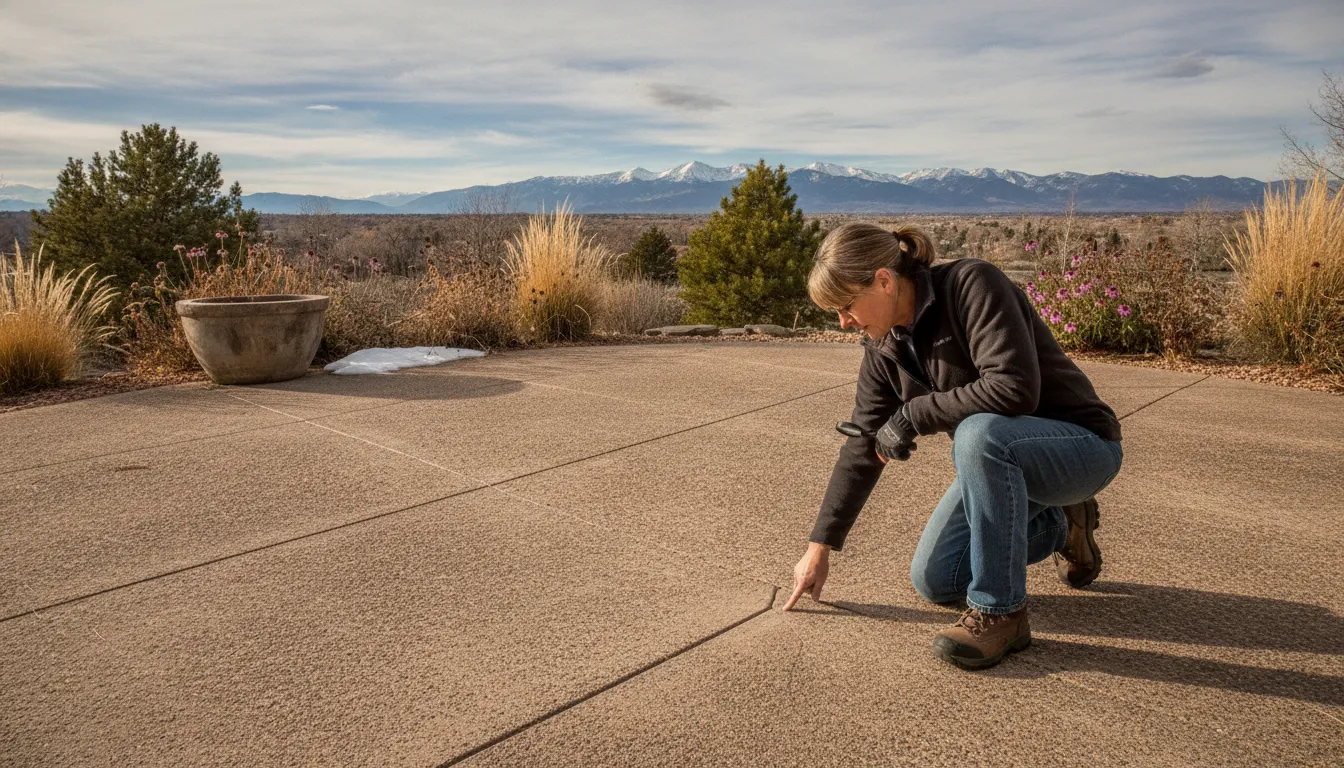
A crack across a patio can look alarming, but its appearance alone does not show whether the slab is failing. In the Denver Metro Area, notice how it relates to nearby joints, the slab’s level, drainage, and whether anything appears to be changing.
Contact Faros about a concrete patio concern
If you need crack repair in concrete patio Denver CO, start with this: not every crack needs the same response. Concrete moves as moisture and temperature change. Planned joints guide where some cracks form. A line may be cosmetic, while movement or other changes may call for an on-site assessment. The National Ready Mixed Concrete Association’s guidance explains that irregular cracks do not necessarily affect concrete integrity.
Understanding how cracks form provides useful context, but no single pattern proves the cause. Look first at the difference between a planned joint and an unplanned crack, then consider what the surrounding slab may reveal.
Why Concrete Patio Cracks Form, and What the Pattern Can Tell You
Concrete patios can develop cracks as the material shrinks and responds to changes in moisture and temperature. Planned joints help guide some of that movement, but a crack’s shape or location alone cannot confirm whether it is cosmetic or connected to a deeper issue.
Shrinkage and seasonal movement
Concrete changes dimension as moisture and temperature change. As newly placed concrete dries, it can shrink; if that movement is restrained, stress may result in a crack. Existing cracks can also widen as drying continues. The National Ready Mixed Concrete Association (NRMCA) explains these movement and shrinkage mechanisms in its concrete cracking guidance.
These causes do not mean every visible line signals a failing patio. NRMCA notes that many early random cracks are unattractive but rarely affect concrete’s structural integrity or service life. Some irregular cracks likewise may not affect integrity. Still, appearance is only one observation, not a reliable diagnosis.
Cracks that appear away from a joint can have several explanations, including restrained shrinkage or conditions related to support. A straight, narrow line is not automatically harmless, and a branching or irregular line does not automatically mean the slab is failing. The useful question is whether the crack is stable and how it relates to the surrounding slab and site.
Joints guide where cracks may form
Control joints are planned weakened planes that encourage dimensional-change cracks to form in selected locations. A crack near or along a joint may be consistent with that purpose, while a crack elsewhere may reflect movement that was not controlled at the intended location. Neither pattern, by itself, establishes the patio’s condition or the right response.
Isolation joints serve a different role: they separate a patio from adjoining elements such as a sidewalk, wall, or stair, allowing those parts to move independently. When movement is restrained or joints are absent or poorly located, cracking can occur in less predictable places. Joints help manage cracking, but they cannot eliminate it.
When a crack deserves closer attention
Cracks can also relate to load and support conditions, and concrete has several possible crack types, including settlement and freeze-thaw patterns. NRMCA’s overview of concrete cracking causes discusses how design, construction, and support conditions can contribute. A changing crack, a visible difference in slab height, or signs of ongoing movement merit a closer look. Those clues do not identify a cause on their own.
For a patio in the Denver Metro Area, avoid deciding on repair from a photograph or crack pattern alone. A site review can consider the slab, surrounding support, and conditions that may affect movement. Faros’s concrete contracting and repair services include patio work; an assessment helps clarify which approach fits the actual condition.
When Do You Need Crack Repair in a Concrete Patio in Denver, CO?
A crack deserves a closer look when it changes, sits beside a raised or settled slab edge, or appears alongside recurring water problems. Those signs do not identify the cause on their own, but they help show when an on-site assessment is more useful than judging the surface from a photo.
Note where the crack begins and ends, whether it follows a joint, and whether its appearance changes over time. A crack that seems to widen, reappear after patching, or coincide with a visible difference in slab height merits attention. Concrete cracking can relate to different conditions, including settlement and freeze-thaw patterns, so the pattern alone is not a reliable diagnosis. The National Ready Mixed Concrete Association’s overview of concrete cracking identifies several distinct crack types.
Look at water and the surrounding ground
After rain or snowmelt, observe whether water repeatedly collects on the patio, runs toward the home, or washes soil from beside the slab. A crack that stays damp or is near erosion is worth mentioning during an assessment. Water entering concrete can contribute to further material damage during freeze-thaw exposure, as described in this National Institute of Standards and Technology study. That does not mean every wet crack is failing; it makes the water pattern part of the evidence.
Drainage depends on more than the patio surface. Slab slope, nearby grading, soil, and where runoff travels can all matter. The NRMCA notes that the slab and subgrade should be sloped for drainage, while Oklahoma State University Extension’s drainage guidance explains that hard surfaces can direct runoff toward low or ponded areas. Faros also discusses backyard grading and drainage planning as a related site consideration.
Track movement without trying to diagnose it
Pay attention to whether the crack appears to extend, whether one side seems higher, and whether nearby soil has washed away or changed. These observations can help a professional consider support and movement, but they cannot establish structural safety remotely. Avoid treating a particular crack shape or width as a pass-or-fail test.
If you see a changing crack together with slab offset, persistent pooling, or erosion, arrange an assessment rather than covering the surface first. The useful question is not simply how the crack looks, but whether water, slope, support. Or movement is contributing to the condition and should be addressed along with the concrete.
What a Professional Patio Crack Inspection Should Consider
A useful inspection looks beyond the visible line to how the patio, its joints, support, slope, and surrounding site conditions fit together. Those observations help guide a next step, but a crack’s appearance alone does not establish its cause.
Start with a map of the slab. Note where each crack begins and ends, whether it follows or crosses a joint, and whether nearby cracks form a broader pattern. Joints help control where cracks form, so recording their relationship gives the assessor useful context. The National Ready Mixed Concrete Association describes several crack types, including settlement and freeze-thaw patterns (NRMCA guidance on concrete cracking). A pattern alone is not a diagnosis.
Next, compare the slab’s surface and edges. An assessor may note whether one side of a crack sits higher, whether an edge appears to have shifted, or whether the patio feels uneven underfoot. These are observations to document, not proof of settlement or a structural defect. The amount and direction of support and loading can affect concrete movement, according to the NRMCA, so context matters as much as the crack itself (concrete support and load conditions).
Drainage deserves a close look. Consider where water flows after rain or snowmelt, whether it collects on the patio, and whether soil near the slab shows erosion or persistent wetness. Slab slope is one part of drainage, while grading, soil, and other site conditions can also influence where water goes. If the patio concern is connected to broader yard runoff, see Faros’ backyard grading and drainage planning information.
Finally, record when the crack appeared, whether it seems to be changing, and how it affects everyday use. Photos taken from the same position over time can help describe progression, but they cannot replace an on-site assessment. Note nearby changes such as new landscaping, altered drainage, or work beside the slab without assuming any one factor caused the crack.
Faros describes site assessment as considering existing conditions, including soil and slope. Homeowners can review its concrete contracting and repair services to understand the documented scope. A professional can explain what was observed, what remains uncertain, and which options merit consideration for the patio.
How Do Repair, Resurfacing, or Replacement Compare?
The right response depends on whether the problem is confined to a crack or surface, or tied to movement, support, or drainage beneath and around the patio. A site assessment helps distinguish those conditions before choosing a scope of work.
A crack’s appearance alone cannot confirm its cause. Concrete responds to moisture, temperature, load, and support conditions, while site slope and soil can also shape project requirements. The National Ready Mixed Concrete Association identifies base preparation and jointing among factors associated with cracking, so a surface-only treatment may not address an underlying condition.
Contact Faros to discuss your concrete patio repair options.
| Approach | When it may fit | What it addresses | Important limitation |
|---|---|---|---|
| Localized repair | Damage appears limited to a particular area, and the surrounding slab does not show broader instability. | Targets a confined crack or damaged section rather than renewing the entire patio surface. | If the crack reflects ongoing movement, weak support, or water-related conditions, treating that spot alone may leave the cause unresolved. |
| Resurfacing | The slab is a candidate for a new finish, with condition and suitability confirmed during assessment. | Renews the visible surface and can be part of addressing worn concrete and cracks, as described in Faros’s concrete service information. | A new finish does not by itself correct movement, poor support, or drainage concerns below or beside the slab. Existing concrete condition matters. |
| Partial or full replacement | Damage or movement is more extensive, or the affected area cannot be addressed appropriately with localized work or a new finish. | Replaces a selected section or the patio slab, allowing the project scope to respond to broader site conditions. | The necessary scope depends on inspection of the slab and site. Replacing concrete without addressing contributing support or drainage conditions may not resolve the underlying issue. |
These are decision categories, not diagnoses. An evaluation should consider the crack pattern, nearby joints, changes in elevation, how the patio sheds water, and whether the problem appears to be changing. Where water is part of the concern, drainage depends on several site factors; any response should avoid directing runoff toward neighboring property. Oklahoma State University Extension notes that grading, slope, soil, and other landscape conditions can combine to affect drainage.
When comparing scopes, separate the visible finish from the condition of the concrete and the site beneath it. Resurfacing is surface-focused, while replacement changes the affected concrete itself; neither should be treated as a cure for a cause that has not been identified. A partial scope may suit a confined area, while broader damage may call for evaluating more of the slab. The boundary depends on how the patio is built and what inspection finds, not a universal crack measurement.
Faros documents concrete repair and resurfacing for worn surfaces and cracks, and its site assessment considers conditions such as soil and slope. For a related topic on a different surface, see repair options for concrete driveways; driveway guidance is not a substitute for evaluating a patio.
Sources: NRMCA guidance on concrete cracking; Oklahoma State University Extension on landscape drainage; Faros concrete services.
How to Reduce Repeat Cracks in a Denver Metro Area Patio
Watch how water moves, then address site conditions around the slab. This can help reduce repeat patio trouble. For future concrete work, thoughtful base preparation, drainage planning, and joint placement can help manage cracking, but they cannot guarantee a crack-free patio.
Track where water collects
After rain or snowmelt, note where water remains on the patio and where it flows along its edges. Check for soil washing away, persistently wet areas, or water collecting beside the slab. These observations can help identify patterns to share during an assessment. Concrete and other hard surfaces can direct runoff toward lower or ponded areas, while grading, soil, slope, and surrounding landscape conditions all affect drainage. Research on drainage in urban landscapes explains why several site conditions may contribute at once.
Keep existing drainage openings and channels clear of leaves and debris, and pay attention to where downspouts or other outlets discharge. Water should not be redirected in a way that creates a new problem for a neighboring property. If water continues to pool or erosion appears, consider the broader yard drainage plan, not just the patio surface. Faros’s guide to Denver yard drainage solutions covers runoff paths and drainage around hardscapes.
Plan the slab and joints as a system
When planning future concrete work, discuss both the base and joint layout with the contractor. The subgrade, or prepared ground beneath the slab, and the slab itself should be considered for drainage. Joint placement also matters: planned joints help direct where cracks may form as concrete changes dimension, while isolation joints allow a patio and adjacent structures to move independently. These details help control cracking, but concrete cracks cannot be eliminated entirely. The National Ready Mixed Concrete Association describes subgrade preparation, jointing, and drainage slope among the construction considerations that influence performance. Read the NRMCA’s concrete construction guidance.
For a future project, Faros’s guide to concrete patio slab preparation outlines site preparation, drainage, and other planning details. If an existing crack keeps changing, water repeatedly collects nearby, or the slab appears to move, have the site assessed before deciding on a surface-only response. Drainage, support, and crack movement can have related causes, so a durable plan should account for the conditions together.
FAQ: Concrete Patio Crack Repair
Crack repair decisions depend on the full patio and site, not just one visible line. These answers cover common first questions, but an on-site review is needed when movement or drainage may be involved.
Can a cracked concrete patio be repaired?
Often, yes, but the right approach depends on what caused the crack and whether the slab is stable. A localized surface issue may call for a different response than a crack associated with movement, poor support, or drainage. Concrete can crack for several reasons, so an on-site assessment is more reliable than judging from a photo alone. NRMCA describes several distinct crack types and causes.
Should hairline cracks in concrete be repaired?
Not every hairline crack needs the same treatment. Some cracks are mainly an appearance concern, while changes over time, an uneven surface, or water collecting nearby may warrant a closer look. Note whether the crack changes and whether it follows a joint; appearance by itself cannot confirm the cause. NRMCA notes that irregular cracks do not necessarily affect concrete integrity.
What can I cover a cracked concrete patio with?
Resurfacing may be an option when the existing slab is suitable for a new finish. But a covering will not resolve ongoing movement or a drainage problem beneath or around the patio. Have the surface and underlying conditions assessed before choosing a finish, so the work addresses the actual issue rather than hiding its signs.
How can I tell whether a patio crack involves movement or drainage?
Look for changes such as one side sitting higher, a crack that appears to be widening, water pooling after rain, or soil washing away near the slab. These clues can help guide an inspection, but they do not establish a diagnosis on their own. Drainage depends on factors such as grading, slope, and soil, so the surrounding area matters too. Oklahoma State University Extension explains how these conditions can combine.
A closer look at the patio and its surrounding conditions can help clarify whether repair or resurfacing is an appropriate next step. Faros Construction Services documents concrete repair and resurfacing for homeowners in the Denver Metro Area.
Author: Ricardo Alfaro
Contact Faros to discuss your patio concern and the next step for your project.