
A concrete patio is one of the most practical and lasting upgrades you can make to a Denver home. But our local climate, with its intense UV exposure, afternoon hailstorms, and over 50 freeze-thaw cycles per year, demands more than a basic pour. The right contractor, the right mix design, and the right preparation make the difference between a patio that cracks in two winters and one that looks great for decades.
This guide covers every step of concrete patio installation in Denver, from cost planning and design options to contractor selection, maintenance, and common mistakes to avoid. Whether you want a simple broom-finish slab, a stamped decorative patio, or a complete backyard living space design, you will find the details that matter for our Colorado conditions right here.
Key Takeaways
- Budget $6 to $12 per square foot for standard concrete and $12 to $20+ for stamped or decorative finishes. A typical 400 sq ft Denver patio runs $2,400 to $8,000 depending on design complexity.
- Denver’s freeze-thaw cycles require air-entrained concrete and a compacted gravel base at least 4 inches deep. Skipping either step leads to cracking within the first few winters.
- Hire a licensed, insured Denver contractor who knows local soil conditions, drainage requirements, and Denver-area building codes. Ask for proof of liability insurance and at least three local references.
- Seal your patio every 2 to 3 years to protect against moisture penetration, salt damage, and UV fading. Proper sealing can double your patio’s functional lifespan.
Concrete Patio Cost Factors in Denver
Several variables determine what you will pay for a concrete patio in the Denver metro area. Understanding these cost factors before you request quotes helps you make informed decisions and avoid surprise charges.
Patio Size and Design Complexity
Size is the biggest cost driver. A simple rectangular 10×12 patio costs far less per square foot than a large, curved, or multi-level design. Complex shapes require more formwork, additional labor hours, and more careful finishing. Most Denver contractors price basic flatwork at $6 to $12 per square foot, with complex layouts adding 20% to 40% to the base price.
Concrete Thickness and Reinforcement
Standard residential patios use 4-inch thick concrete. If your patio needs to support heavy furniture, a hot tub, or vehicle traffic, you may need 5 to 6 inches with rebar or wire mesh reinforcement. Thicker slabs with steel reinforcement add $1 to $3 per square foot but prevent structural cracking under heavy loads.
Decorative Finishes: Stamped, Colored, and Stained
Stamped concrete mimics natural stone, brick, or tile at a fraction of the cost. Integral color, acid staining, and exposed aggregate finishes all add to the base price. Expect to pay $12 to $20+ per square foot for decorative work compared to $6 to $12 for a standard broom finish.
Site Preparation for Denver’s Expansive Soil
Denver sits on bentonite clay, an expansive soil that swells when wet and shrinks when dry. Proper site prep for our soil conditions includes excavation, grading for drainage, and installing a compacted gravel base. Homes in areas like Highlands Ranch, Centennial, and Parker often sit on particularly challenging clay. Budget an extra $500 to $2,000 for significant grading or soil stabilization work.
Freeze-Thaw Rated Materials for Colorado
Denver experiences an average of 50+ freeze-thaw cycles annually. Air-entrained concrete (with 5% to 7% air content) is required here. This mix design creates microscopic air pockets that absorb the pressure of freezing water inside the slab, preventing spalling and surface pop-outs. Most reputable Denver contractors use air-entrained mixes by default, but confirm this before signing any contract.
How Much Does a Concrete Patio Cost in Denver?
A concrete patio in Denver costs between $6 and $12 per square foot for a standard broom-finish slab, and $12 to $20+ per square foot for stamped or decorative options. Here is what to expect at different price points.
Standard Concrete Patio Pricing
For a basic, broom-finished concrete patio with no decorative elements:
- Small patio (100-200 sq ft): $800 to $2,400
- Medium patio (200-400 sq ft): $1,600 to $4,800
- Large patio (400-600 sq ft): $3,200 to $7,200
These ranges include standard site preparation, a 4-inch gravel base, 4-inch slab thickness, and basic finishing. They do not include permits, demolition of existing surfaces, or grading corrections.
Premium and Decorative Concrete Options
Decorative concrete opens up a wide range of design possibilities for your Denver patio:
- Stamped concrete: $12 to $18 per sq ft. Replicates the look of flagstone, slate, brick, or wood planks.
- Colored/stained concrete: $8 to $15 per sq ft. Integral color mixed into the concrete or acid stain applied after curing.
- Exposed aggregate: $10 to $16 per sq ft. Reveals the natural stone within the mix for a textured, slip-resistant surface.
- Polished concrete: $8 to $14 per sq ft. Smooth, modern finish best for covered patio areas.
Additional Features and Upgrades
Common add-ons that affect your final budget:
- Retaining walls or seat walls: $20 to $45 per linear foot
- Built-in fire pit pad: $500 to $2,000
- Steps or grade transitions: $200 to $500 per step
- Drainage system: $500 to $1,500 for a French drain or channel system
Seasonal Pricing Considerations
Denver’s construction season runs from April through October. Concrete contractors are busiest from May through September, and you may see 10% to 15% premium pricing during peak summer months. Scheduling your project in early spring (April) or fall (September-October) can sometimes yield better pricing and faster start dates. Winter pours are possible with heated blankets and cold-weather additives, but they add cost and risk.
Concrete Patio Designs for Denver’s Climate
The best patio design for your Denver home balances visual appeal with weather durability. Here are the most popular options and how they perform in our local conditions.
Stamped Concrete Patios
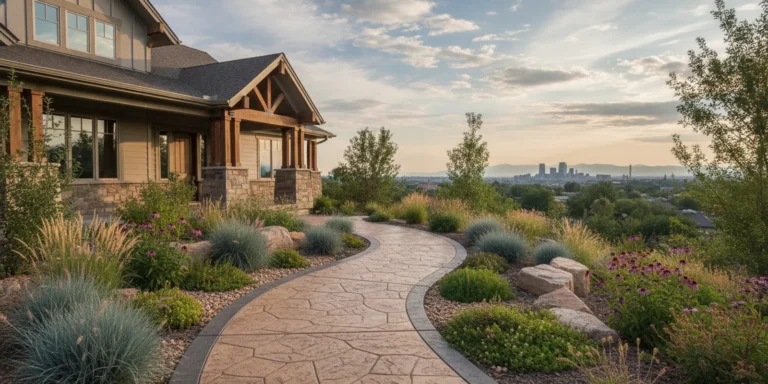
Stamped concrete is the most popular decorative option for Denver patios. Large rubber stamps press patterns into freshly poured concrete, creating surfaces that look like natural stone, brick, slate, or even wood planks. The finish is applied while the concrete is still wet, so the pattern becomes a permanent part of the slab.
For Denver, ashlar slate and flagstone patterns are popular choices because they complement both modern and traditional home styles. One important note: stamped surfaces should be sealed with a non-slip additive to maintain traction during Colorado’s icy winter months.
Colored and Stained Concrete
Concrete color comes in two forms: integral color mixed into the wet concrete before pouring, and acid or water-based stain applied to the cured surface. Integral color is more durable and fade-resistant, making it the better choice for sun-exposed Denver patios. Stains create more varied, translucent tones and work well for covered areas or patios with less direct UV exposure.
Earth tones, sandstone, and terra cotta colors tend to hold up best in Colorado’s high-altitude sun. Darker colors absorb more heat, which can help melt light snow but may be uncomfortably warm in direct summer sun.
Exposed Aggregate for Slip Resistance
Exposed aggregate finishes wash away the surface cement paste to reveal the natural stones within the concrete. This creates a pebbled texture that provides excellent traction, even when wet or icy. It is one of the most practical finish choices for Denver patios that see regular snow and ice.
The slip resistance, combined with visual interest and low maintenance, makes exposed aggregate a smart pick for pool surrounds, walkways, and patios near sloped grades.
Weather-Smart Design for Colorado
Every patio design decision in Denver should account for our unique weather patterns:
- Drainage slope: A minimum 1/4 inch per foot slope away from your home’s foundation prevents water pooling and ice buildup.
- Control joints: Cut at every 8 to 10 feet (and at a ratio of 2-3x the slab thickness) to control where cracking occurs.
- Expansion gaps: Leave a 1/2 inch gap where the patio meets your house, garage, or other structures to allow for thermal expansion.
- UV-stable sealers: Colorado’s intense high-altitude UV degrades standard sealers faster than at sea level. Use a UV-resistant acrylic or polyurethane sealer.
How to Choose a Concrete Patio Contractor in Denver
Your contractor choice has more impact on your patio’s long-term performance than any material or design decision. Here is what to look for when hiring in the Denver metro area.
Licensing and Qualifications
Colorado does not require a statewide contractor license, but many Denver-area municipalities require local licensing and permits for concrete work. Your contractor should carry:
- General liability insurance (minimum $1 million)
- Workers’ compensation coverage
- A current city or county business license
- Experience with Denver’s soil conditions and building codes
Faros Construction Services carries full insurance and has over 30 years of combined construction experience in the Denver metro area, with deep knowledge of our local soil, climate, and permitting requirements.
Questions to Ask Before Hiring
Before signing a contract with any concrete contractor, ask these questions:
- Do you use air-entrained concrete for all outdoor pours?
- What base preparation do you use for Denver’s clay soil?
- How do you handle drainage grading?
- What is your control joint placement plan?
- Do you pull the necessary permits?
- What warranty do you offer on your work?
- Can you provide three local references from the past 12 months?
Red Flags to Avoid
- No written contract or vague scope of work. Every detail should be in writing before work begins.
- Requesting full payment upfront. A standard payment schedule is 10% to 30% deposit, with the balance due at completion.
- No proof of insurance. Uninsured contractors put you at financial risk for injuries or property damage.
- Unwillingness to pull permits. Unpermitted work can create problems when selling your home.
- Prices far below market rate. The lowest bid often means corners are being cut on materials, base preparation, or concrete quality.
Getting Accurate Estimates and Timelines
Get at least three written estimates for your patio project. Each estimate should itemize: demolition (if applicable), excavation and grading, base material and compaction, concrete (including mix specification), finishing, sealing, and cleanup. A standard residential patio project in Denver takes 1 to 3 days for the pour and finishing, plus 5 to 7 days of curing time before you can place furniture.
Concrete Patio Maintenance in Denver
Denver’s climate is hard on outdoor concrete. A consistent maintenance routine keeps your patio looking good and performing well for decades.
Sealing Schedule for Protection
Seal your concrete patio every 2 to 3 years using a penetrating or acrylic sealer rated for UV exposure. Denver’s high altitude means stronger UV radiation, which breaks down sealers faster than in lower-elevation cities. Apply sealer in late spring or early fall when temperatures stay between 50 and 80 degrees Fahrenheit for at least 24 hours.
A properly sealed patio resists moisture absorption, salt damage from de-icing products, and staining from food and grill drippings.
Seasonal Cleaning Tips
- Spring: Power wash at 2,500 to 3,000 PSI to remove winter grime and de-icing salt residue. Inspect for any new cracks.
- Summer: Sweep regularly to prevent dirt buildup. Address stains from grilling or outdoor dining promptly with a concrete-safe degreaser.
- Fall: Clear leaves before they stain the surface. This is the best time to apply sealer before winter.
- Winter: Use sand or kitty litter instead of rock salt for traction. If you must use de-icer, choose calcium magnesium acetate (CMA) or products rated safe for concrete.
Crack Prevention and Repair
Small hairline cracks are normal in concrete and do not affect structural integrity. Wider cracks (over 1/4 inch) should be filled with a flexible concrete caulk or polyurethane sealant before winter to prevent water from entering and freeze-thaw cycling from widening the damage.
Prevent cracking by maintaining good drainage around the patio, keeping soil moisture levels consistent (avoid overwatering landscaping directly adjacent to the slab), and re-sealing on schedule.
Long-Term Concrete Durability
With proper installation and maintenance, a concrete patio in Denver lasts 25 to 50 years. The key factors that extend lifespan are: air-entrained concrete mix, adequate base preparation, correct control joint spacing, regular sealing, and avoiding harsh chemical de-icers. Concrete outlasts most alternative patio materials in our climate, including wood decking (10-25 years) and some paver installations that settle unevenly on Denver’s clay soil.
Common Concrete Patio Installation Mistakes
Avoid these common errors that Denver homeowners and inexperienced contractors make during patio installation.
Drainage and Grading Errors
A patio that slopes toward your house or pools water in the center is a recipe for foundation damage and ice hazards. Proper grading requires a minimum 1/4 inch per foot slope away from all structures. In Denver, where afternoon thunderstorms can dump heavy rain in minutes, drainage planning is not optional.
Inadequate Base Preparation
Pouring concrete directly on Denver’s clay soil without a gravel base leads to settling and cracking, sometimes within the first season. A minimum 4-inch layer of compacted Class 6 road base (or 3/4-inch crushed gravel) provides the stable, well-drained foundation that clay soil cannot.
Incorrect Control Joint Placement
Control joints are intentional weak points that direct cracking along planned lines. Without them, concrete cracks randomly and unevenly. Joints should be cut to a depth of 1/4 the slab thickness and spaced no more than 8 to 10 feet apart (a general rule is 2 to 3 times the slab thickness in feet). Panels should be as close to square as possible, avoiding long, narrow shapes.
Denver Permit and Building Code Requirements
Many Denver-area municipalities require permits for concrete patio work, especially for patios exceeding certain size thresholds, those near property lines or easements, or those requiring significant grading changes. Skipping permits can result in fines and complicate future home sales. Your contractor should handle all permit applications and inspections as part of the project scope.
Concrete Patio vs. Pavers: Which Is Better?
Denver homeowners often debate between poured concrete and pavers for their patio. Both are solid choices, but they differ in cost, maintenance, and performance in our climate. Here is a direct comparison.
| Feature | Concrete Patio | Paver Patio |
|---|---|---|
| Cost per sq ft (installed) | $6-$12 standard, $12-$20 decorative | $10-$25 |
| Lifespan | 25-50 years | 25-50 years |
| Maintenance | Seal every 2-3 years | Re-sand joints, replace shifted pavers |
| Freeze-thaw performance | Excellent with air-entrained mix | Good with proper base and drainage |
| Design flexibility | Stamped, colored, stained options | Wide variety of shapes, colors, patterns |
| Repair | Patch or overlay (visible) | Replace individual pavers (blends in) |
| Installation time | 1-3 days + 7 days curing | 3-5 days, usable immediately |
| Best for | Large, uniform areas; modern designs | Complex shapes; homeowners who want easy repair |
Bottom line: For large patios on a budget, poured concrete typically costs less and requires less ongoing maintenance. Pavers offer easier individual repairs and more design variety but come at a higher upfront cost. In Denver’s climate, both perform well when installed correctly with proper base preparation and drainage.
Frequently Asked Questions
How much does a concrete patio cost in Denver?
A standard concrete patio in Denver costs between $6 and $12 per square foot for basic finishes. A 20×20 patio (400 sq ft) typically runs $2,400 to $4,800. Stamped or decorative concrete can range from $12 to $20+ per square foot depending on the complexity of the design and site conditions.
How much should a 20×20 concrete patio cost?
A 20×20 concrete patio (400 square feet) in Denver typically costs $2,400 to $4,800 for a standard broom-finish slab. Stamped concrete or decorative options for the same area range from $4,800 to $8,000 or more. Site preparation, soil conditions, and accessibility can also affect the final price.
How long does a concrete patio last in Denver?
A properly installed and sealed concrete patio in Denver lasts 25 to 50 years. Denver’s freeze-thaw cycles require air-entrained concrete and regular sealing every 2 to 3 years to maximize the lifespan. With proper maintenance, concrete outlasts most alternative patio materials.
Is it cheaper to pour concrete or lay pavers?
Poured concrete is generally cheaper upfront at $6 to $12 per square foot, while pavers typically cost $10 to $25 per square foot installed. However, pavers are easier to repair individually. For large patios in Denver, concrete often provides the best value for durability and low maintenance.
What is the best time of year to pour a concrete patio in Denver?
The best time to pour a concrete patio in Denver is late spring (May-June) or early fall (September-October). Temperatures between 50 and 80 degrees Fahrenheit provide ideal curing conditions. Avoid pouring during extreme heat (above 90 degrees) or when overnight temperatures drop below 40 degrees, as both can weaken the finished slab.
Do I need a permit for a concrete patio in Denver?
Permit requirements vary by municipality in the Denver metro area. Many cities require permits for patios exceeding certain size thresholds or those built near property lines. Check with your local building department or hire a concrete contractor Denver who handles permitting as part of the project.