
If you are replacing or installing a new driveway on your Denver home, you are likely weighing concrete versus asphalt. Both materials serve the same basic purpose, but they perform very differently in Colorado’s climate. Denver’s high altitude, extreme UV exposure, expansive clay soils, and over 100 annual freeze-thaw cycles mean the choice matters more here than in most US cities.
Get a free quote from Faros Construction for your Denver driveway project.
This complete guide breaks down every factor Denver homeowners need to consider: upfront investment, lifespan, maintenance demands, freeze-thaw performance, appearance options, resale value, installation timelines, and contractor selection. By the end, you will have a clear framework for the right choice for your home.
Concrete vs Asphalt Driveway: The Short Answer for Denver Homes
Concrete driveways are the better long-term investment for most Denver homeowners. Concrete lasts 30 to 50 years with minimal maintenance, handles freeze-thaw cycles well when air-entrained, and offers significantly more design flexibility. Asphalt driveways have a lower upfront expense but require more frequent maintenance and replacement every 15 to 20 years, making them more expensive over a 30-year period. Asphalt can make sense for short-term ownership (under 5 years), very long rural driveways, or tight immediate budgets, but concrete delivers better value for the vast majority of Denver properties.
How Does Denver’s Climate Affect Driveway Materials?
Denver’s climate is uniquely demanding for driveways. Understanding how each material reacts to local conditions is the foundation of a smart decision.
Freeze-Thaw Cycles
Denver averages over 100 freeze-thaw cycles per year. Water seeps into surface cracks, freezes, expands, and breaks the material from the inside. Air-entrained concrete (containing 6% to 8% microscopic air bubbles) gives water room to expand without cracking the matrix. Asphalt is flexible enough to tolerate some movement, but its petroleum-based binder becomes brittle in sustained cold and softens in summer heat, accelerating degradation.
UV Exposure at Altitude
Denver sits at 5,280 feet, where UV radiation is roughly 25% stronger than at sea level. This breaks down asphalt’s binder faster than in lower-altitude cities, causing the surface to turn gray and brittle within 5 to 7 years without regular sealcoating. Concrete does not suffer from UV degradation, maintaining its structural integrity and appearance for decades.
Expansive Clay Soils
Many Denver neighborhoods sit on bentonite clay soils that expand significantly when wet and contract when dry. This soil movement puts stress on any driveway surface. Concrete slabs with proper control joints and a well-compacted subbase handle this movement better than asphalt, which can develop alligator cracking and depressions over unstable soils.
Comparing Lifespans: Which Material Lasts Longer in Colorado?
Lifespan is the single biggest differentiator between concrete and asphalt driveways, and the gap widens further in Denver’s climate.
A well-installed concrete driveway in Denver lasts 30 to 50 years with basic maintenance. According to the National Ready Mixed Concrete Association (NRMCA), concrete’s compressive strength increases over time as it continues to cure. After 28 days, a standard 4,000 PSI residential mix reaches its rated strength and continues to harden for years after that. This means a concrete driveway actually gets stronger with age.
Asphalt driveways typically last 15 to 20 years before needing full replacement. The binder oxidation that breaks down asphalt happens faster at Denver’s altitude. Without regular sealcoating every 2 to 3 years, the surface becomes brittle and cracks form. Once water penetrates the base layer, the entire driveway begins to fail and resurfacing or full replacement is needed.
| Factor | Concrete | Asphalt |
|---|---|---|
| Typical lifespan | 30 to 50 years | 15 to 20 years |
| Denver climate impact | Minimal with air-entrained mix | UV and freeze-thaw accelerate wear |
| Strength over time | Increases (continues curing) | Decreases (binder oxidizes) |
| Full replacement needed | Rarely in a homeowner’s tenure | Once or twice in 30 years |
What Maintenance Do Concrete and Asphalt Driveways Require?
Maintenance obligations differ significantly between the two materials and have a major impact on total long-term commitment.
Concrete Driveway Maintenance
Concrete requires sealing every 3 to 5 years with a penetrating salt-resistant sealer. Annual cleaning with a pressure washer keeps oil stains and dirt from building up. Control joints should be inspected and resealed if cracks appear at the saw cuts. Spot repairs for isolated surface issues are possible without affecting the rest of the driveway. Major structural problems like slab settlement are rare when the base was prepared correctly during installation.
Asphalt Driveway Maintenance
Asphalt needs sealcoating every 2 to 3 years to protect the binder from UV degradation and water infiltration. Cracks should be filled annually with hot rubber crack filler before they widen and allow water into the base layer. Potholes and depressions develop as the base erodes and typically require patching every 5 to 7 years. resurfacing (a new top layer) is usually needed at the 10 to 15 year mark. At year 15 to 20, full replacement is required.
| Maintenance Task | Concrete | Asphalt |
|---|---|---|
| Sealing | Every 3 to 5 years | Every 2 to 3 years |
| Crack repair | Rare (joint resealing only) | Annual |
| Pressure washing | Once or twice per year | Once per year |
| Resurfacing | Not needed | At year 10 to 15 |
| Full replacement | 30 to 50 years | 15 to 20 years |
Learn more about the concrete curing process specific to Colorado’s climate for a deeper understanding of how proper installation affects long-term durability.
Concrete vs Asphalt: 30-Year Financial Comparison
While the upfront expense of asphalt is lower, the long-term picture tells a different story. Over 30 years of ownership, concrete driveways typically require less total spending because they avoid a full replacement cycle and have lower cumulative maintenance demands.
The Michigan Department of Transportation tracked pavement longevity across thousands of road miles and found concrete pavement lasts an average of 27.5 years before needing major repairs, compared to 15.5 years for asphalt. For residential driveways, the gap is similar. A concrete driveway installed today will likely still be in service 30 years from now. An asphalt driveway will need at least one, possibly two, full replacements in that same period.
For a standard two-car driveway (roughly 500 square feet), here is how the long-term comparison breaks down:
| Category | Concrete | Asphalt |
|---|---|---|
| Initial installation | Higher upfront investment | Lower upfront investment |
| Maintenance over 30 years | Sealing every 3 to 5 years | Sealcoating + crack repair + resurfacing |
| Replacement cycles | None needed | 1 to 2 full replacements |
| 30-year total | Lower overall | Higher overall |
| Best financial fit | Long-term homeowners | Short-term or budget-priority projects |
Appearance and Design Options for Your Denver Home
The visual impact of your driveway matters for curb appeal and resale value, especially in Denver’s competitive housing market.
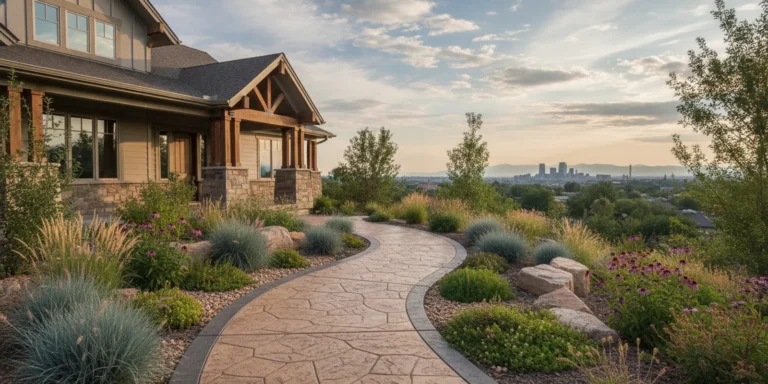
Concrete offers extensive design flexibility. Homeowners can choose from broom finishes for a classic look, exposed aggregate for texture and slip resistance, stamped patterns that mimic stone or brick, and integral coloring for a custom hue. Concrete can also be scored or stained to complement the architectural style of the home. These options allow a concrete driveway to enhance overall property aesthetics rather than just serving as a functional surface.
Asphalt is limited to a standard black or dark gray surface. While some contractors offer dyed asphalt or stamped overlay techniques, these options are less durable and more expensive than decorative concrete finishes. Asphalt’s appearance degrades noticeably over time as the surface fades to gray and cracks develop, reducing curb appeal.
Freeze-Thaw Performance: Which Material Wins in Denver Winters?
Denver winters test driveway materials harder than almost any other climate factor. The city’s temperature swings of 40 degrees or more within a single day create expansion and contraction stress on both materials.
Concrete handles freeze-thaw conditions best when installed with an air-entrained mix specifically formulated for Colorado’s climate. The microscopic air bubbles in air-entrained concrete create space for water to expand when it freezes, preventing internal cracking. This is not an upgrade in Denver; it is the baseline specification for any concrete driveway expected to last more than a decade. A standard 4,000 PSI mix with 6% to 8% air entrainment is the industry standard for Denver residential driveways.
Asphalt’s flexibility gives it some advantage in ground movement from freeze-thaw cycles. However, the binder becomes brittle in sustained sub-freezing temperatures, and the repeated expansion and contraction accelerates crack formation. Once cracks form, water penetration leads to base erosion and potholes.
A properly installed concrete driveway with a well-compacted subbase, proper drainage, and air-entrained concrete outperforms asphalt in Denver’s freeze-thaw environment over the long term.
Installation Timelines: What to Expect for Each Material
Understanding the installation process and timeline helps with project planning and managing expectations.
Concrete Driveway Installation
Excavation and subbase preparation takes 1 to 2 days. Forming and pouring takes 1 day for a standard driveway. Concrete requires 7 to 28 days to cure before it can support full vehicle weight. Light vehicle traffic is typically allowed after 7 days, but heavy trucks or RVs should wait the full 28-day cure period. The total project timeline is 1 to 2 weeks from start to full use, depending on weather conditions.
Asphalt Driveway Installation
Asphalt is faster to install. Excavation and base preparation takes 1 to 2 days. Paving takes 1 day. Asphalt can support vehicle traffic within 1 to 3 days after installation, though heavy turning should be avoided for about a week. The total project timeline is typically 3 to 5 days from start to full use.
For Denver homeowners, the shorter asphalt timeline is a minor convenience advantage, but it should not outweigh the durability and lifespan benefits of concrete for a long-term property.
Do Concrete or Asphalt Driveways Add More Home Value?
Driveway material affects property resale value, particularly in Denver’s competitive real estate market where curb appeal drives buyer perception. According to data from the National Association of Realtors, exterior home improvement projects that enhance curb appeal recoup 70% to 100% of their expense at resale.
Concrete driveways add measurable resale value because buyers associate them with durability, low maintenance, and premium aesthetics. A well-maintained concrete driveway signals that the property has been cared for. Asphalt driveways have a moderate impact on resale value, and aging or faded asphalt can actually detract from a home’s perceived value during a sale.
For Denver homeowners planning to sell within 5 to 10 years, a concrete driveway provides a stronger return on investment through higher curb appeal and buyer perception.
How to Vet a Driveway Contractor in Denver
The quality of installation matters as much as the material choice. A poorly installed concrete driveway can fail within a few years, while a properly installed one lasts decades.
When evaluating contractors, verify that they have experience with Denver’s specific soil and climate conditions. Ask about subbase preparation depth (8 to 12 inches of compacted gravel is standard for Colorado), reinforcement methods (rebar versus wire mesh), and air-entrained concrete mix specifications. Request references from recent Denver driveway projects and inspect the work in person. Confirm licensing, insurance, and workers’ compensation coverage before signing a contract.
Review our questions to ask a contractor before hiring for a complete vetting checklist.
Should You Choose Concrete or Asphalt for Your Denver Driveway?
The right choice depends on your specific situation. Here is a simple decision framework:
Choose concrete if: You plan to stay in your home for 10 or more years. You want minimal long-term maintenance. Design flexibility and curb appeal matter to you. You have heavy vehicles like RVs or work trucks. You are willing to wait the full cure period before heavy use.
Choose asphalt if: You plan to sell within 5 years and need the lowest possible upfront investment. You have a very long rural driveway where concrete installation logistics are prohibitive. Your current budget cannot accommodate the higher initial expense of concrete. You need the driveway usable within 3 to 5 days.
For the vast majority of Denver homeowners planning to live in their home beyond a few years, concrete is the superior choice. The initial investment pays for itself through decades of reliable service, minimal maintenance, and stronger resale value.
Contact Faros Construction for a consultation on your Denver driveway project.
Frequently Asked Questions About Concrete vs Asphalt Driveways in Denver
Is concrete or asphalt better for Denver’s freeze-thaw climate?
Air-entrained concrete performs better in Denver’s freeze-thaw conditions than asphalt. The microscopic air bubbles give expanding ice room to move without cracking the slab. Asphalt becomes brittle in cold temperatures and its binder degrades faster due to Denver’s high UV exposure at altitude.
How long does a concrete driveway last in Colorado?
A properly installed concrete driveway with air-entrained mix and a well-compacted subbase typically lasts 30 to 50 years in Colorado. Concrete actually gains strength over time as it continues to cure.
How long does an asphalt driveway last in Colorado?
Asphalt driveways in Colorado last 15 to 20 years on average. Denver’s high altitude and intense UV exposure accelerate binder degradation, reducing lifespan compared to lower-altitude regions.
Does a concrete driveway add more home value than asphalt?
Yes. Concrete driveways add more resale value because buyers perceive them as durable, low-maintenance, and aesthetically superior. Exterior improvements that boost curb appeal typically recoup 70% to 100% of their value at resale according to National Association of Realtors data.
Can you install concrete driveways in Denver during winter?
Concrete installation is possible in Denver during winter but requires cold-weather precautions including heated concrete mixes, insulating blankets, and extended cure times. Most contractors prefer to pour between April and October for optimal results.
What is the best concrete mix for Denver driveways?
A 4,000 PSI mix with 6% to 8% air entrainment is the industry standard for Denver residential driveways. This mix provides the freeze-thaw resistance and compressive strength needed for Colorado’s climate.
Should I seal my concrete driveway in Denver?
Yes. A penetrating salt-resistant sealer applied every 3 to 5 years protects your concrete driveway from moisture infiltration, deicing salts, and staining. Sealing is especially important in Denver due to the high number of freeze-thaw cycles and winter road salt exposure.
How much maintenance does an asphalt driveway need in Denver?
Asphalt driveways in Denver require sealcoating every 2 to 3 years, annual crack filling, and resurfacing at the 10 to 15 year mark. The high UV exposure at Denver’s altitude accelerates oxidation, making regular sealcoating essential for extending the driveway’s service life.
Planning Your Denver Driveway Project
Whether you choose concrete or asphalt, proper planning and professional installation determine how well your driveway performs over its lifetime. Start with a site evaluation that includes soil testing for expansive clay, drainage assessment, and subbase requirements. Work with a contractor who understands Denver’s unique conditions and can recommend the right material specification for your property.
For more guidance on durable outdoor materials for your Denver property, see our material selection guide for outdoor structures and learn how proper yard drainage protects your driveway investment.
Get a quote from Faros Construction for professional driveway installation in the Denver metro area.